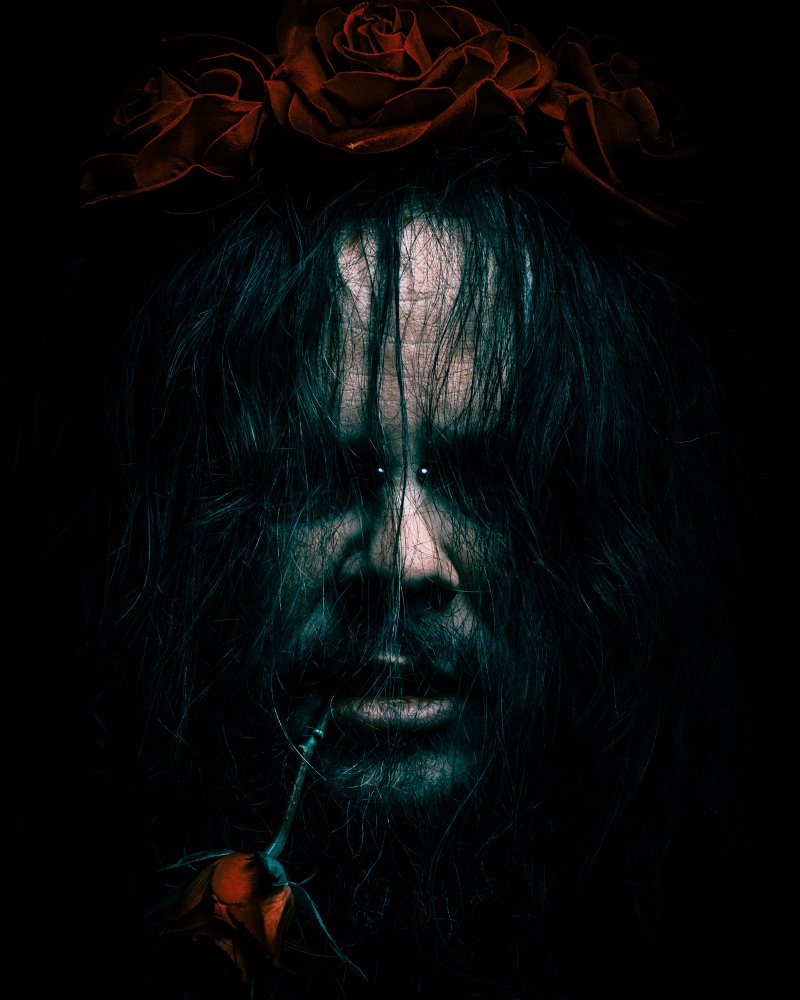
Stillness is usually where my photographs begin. If the frame stays quiet long enough, emotion has room to show up—loneliness, anger, love, whatever is true. The image is finished when that feeling remains, even after the first look.
I live in Tampere, and I work between two spaces that look different but behave the same: the controlled darkness of the studio and the unplanned finds of a walk outside. In both, I’m trying to reduce the scene to what matters. One subject. A clean decision. Space that doesn’t apologize for being empty. Light that feels like a presence instead of a flashlight.
Darkness as a Choice
My photographs lean dark, moody, and gritty because that’s where the signal is easiest to hear. Darkness is not a costume; it’s a filter. It removes the extra explanations the world keeps offering. It simplifies. It makes the frame selective. It lets a face, a texture, a shape, or a moment stand alone without being softened by context.
In that kind of quiet, small things become loud: the edge of a highlight, the pause between gestures, the weight of negative space. The image doesn’t need to shout. It just needs to be precise enough to hold.
Light: Not Illumination, Structure
I started playing with light in the early 2000s, long before photography felt like “my thing.” Years of light direction—especially around electronic music events—taught me what I still trust most: light isn’t only something you add. It’s something that decides. It decides what becomes real in the frame, what disappears, and what emotion is allowed to arrive first.
That background left me with a practical belief that sounds simple but keeps proving itself: lights can be fun, and good light matters. With light you can shape almost anything. Not to make it prettier—just to give it form, intention, and a mood that doesn’t feel accidental.
2018: The Door I Didn’t Plan
Photography became serious for me in 2018 through an indirect door. I got a drone as a present. The drone led to a camera. The camera led to attention. And attention, once it becomes a habit, starts changing what you notice even when you’re not photographing.
I didn’t arrive with a manifesto. I arrived with curiosity and a willingness to chase it. Over time, different hobbies have pulled the work into different shapes, but the core stayed consistent: I keep returning to moments that feel quiet and weighted, moments that don’t ask for spectacle to be meaningful.
Two Worlds, One Instinct
Studio portraits and outdoor work can look like separate genres, but to me they’re one practice with two environments. In the studio, you control what enters the frame. Outside, you discover what’s already there. The difference is logistics, not intent.
In both places I’m looking for the same alignment:
- a single subject that feels unavoidable,
- space that supports the subject instead of competing with it,
- color—or the decision to remove color—used with restraint,
- and light that gives the scene a clear emotional temperature.
When it works, the image feels like it has fewer moving parts than reality, and that reduction is the point.
The Minimal Frame
Minimalism, for me, isn’t a style badge. It’s a way of protecting the image from noise. I’m drawn to a composition that leaves room for the viewer’s mind to settle. Space is not absence; it’s the thing that allows presence to register.
Often I want one subject and nothing else trying to audition for attention. The frame stays quiet so the feeling can be specific. Sometimes that means muted color. Sometimes it means color drained down to a near-memory. Sometimes it means the subject is surrounded by darkness so the smallest highlight becomes a decision.
A minimal frame is a promise: I chose this, and only this.
Ideas First
My photographs usually start with a target rather than a method. I need to know what kind of photo I’m aiming for at a high level—an idea that tells me what the image wants to be.
Sometimes the idea is surreal and simple: a teddy bear in a forest, familiar and wrong in the same breath. Sometimes it’s elemental: a long exposure where rock and water stop being separate things and become one shape, one breath. Sometimes it’s anchored to time: a day like Valentine’s Day approaching, carrying a particular tension—tenderness, expectation, loneliness, or whatever the calendar stirs up in people.
The idea acts like a compass. It keeps the work from becoming a collection of “nice pictures.” It gives the photograph a reason to exist beyond documentation.
Knowing When to Stop
I’m not chasing perfectionism. I work with an 80/20 mindset, because endless refinement can sand off the edge that made the image alive in the first place. I keep working until I can’t see anything meaningful left to improve—then I stop.
That doesn’t mean careless. It means deliberate restraint. The goal is to finish with intention, not exhaustion. I want the image to feel made, not overworked. I want it to keep its original spark—the moment where the photograph first felt inevitable.
Walking My Own Road
I’m self-taught. I’m not interested in building an identity out of reference lists or borrowed vocabulary. I look everywhere for ideas, because ideas aren’t bound to specific artists or a single aesthetic lane. The work needs to stand on its own, and the journey needs to stay mine.
What I’m trying to protect is a simple kind of honesty: if the image carries something real, it doesn’t need credentials around it. If it doesn’t, no amount of framing will fix it. So I keep learning, keep refining, and keep returning to the same core test—does the photograph hold a feeling when everything extra is removed?
What I’m Actually Doing With a Camera
At the center of it, my practice is plain: I believe in capturing beautiful light and the moments it reveals. Not because beauty is the point, but because light can turn the ordinary into something that feels inevitable—something that deserves to be held still for a while.
That’s what I’m after: a small piece of time, compressed into a dark, minimal frame, carrying emotion without explaining itself.
– Timo